14 September 2026 · Forma editorial concept
From brief to spatial story
A useful concept connects the questions in a brief to the spaces shown in its images. Atelier Rooms offers a small example of how activities, relationships and a coherent visual sequence can turn an open-ended idea into something reviewable.
Separate wishes from relationships
A brief may begin with words about atmosphere: warm, open, quiet or collaborative. These can be useful, but they do not yet explain how a space will work. The next step is to ask what people are expected to do and how those activities relate. Where does making happen? Where are materials compared? Where can an unfinished idea be discussed? These questions give the concept a structure that visual preferences alone cannot provide.
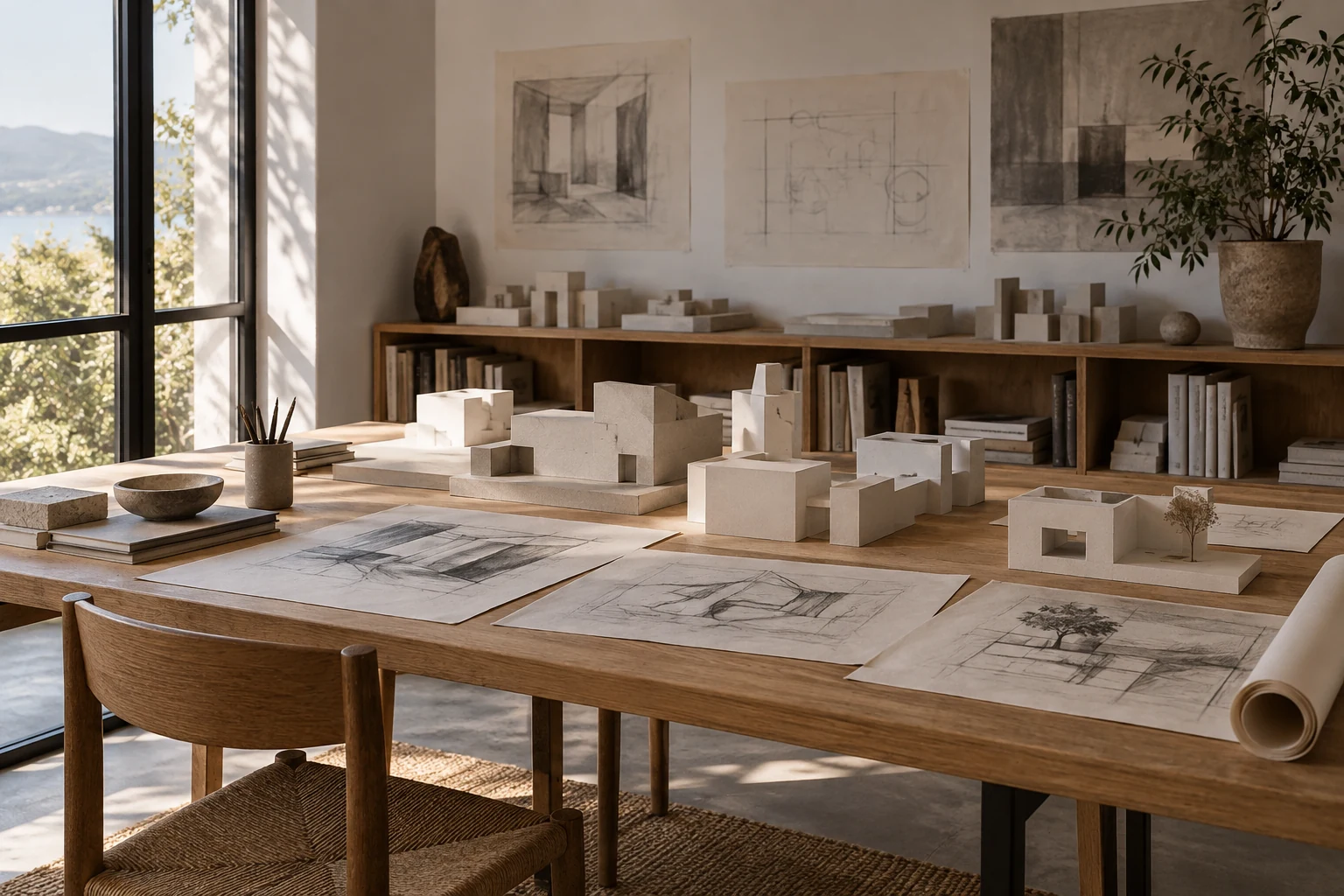
Atelier Rooms begins with the sequence from making to review. Model tables, material shelving and a review wall are not selected simply because they look like a design studio. They represent different activities that need to be connected within the fictional setting.
Make the first diagram modest
An early diagram does not need to resemble a construction drawing. It can show the relationship between activities with simple fields, lines and labels. Its purpose is to make an option understandable. If making and review are adjacent, what does that allow? If material research sits along the route, how does it become part of the process rather than a separate destination?
The diagram should also make assumptions visible. A route drawn through a worktable is not a solution just because the graphic is tidy. The concept needs enough detail to expose questions while remaining open to revision. In this portfolio, diagrams are explicitly conceptual and not for construction.
Develop a sequence of places
Once a direction is selected, the spatial story can be described through several connected views. The model-making tables establish the main activity. Tall material shelves introduce a place for comparison. The route toward the review wall explains how an idea moves from working scale to discussion scale. A smaller corner offers another setting for conversation.
The clerestory openings and concrete floor hold these views together. They provide consistent references that help the viewer recognise the same place. Without those invariants, a gallery can become a collection of attractive workshop images that says little about the actual concept. The sequence needs to add information while retaining identity.
Use images to test the story
Generated imagery is useful only when it is reviewed critically. A view may introduce a new room, change the window arrangement or place furniture in a way that contradicts the route. These changes should be treated as problems to resolve, not as creative variation that automatically improves the project. The brief remains the reference for what the image needs to explain.
Detail views have the same responsibility. A model board, a shelf edge or a material sample can bring the story closer, but it should still belong to the established environment. Books and papers do not need invented brand names or readable technical drawings to make the room feel occupied by work. Ordinary objects can provide character without making false claims about a real practice.
Review against the original questions
A review is most useful when it returns to the activities that began the process. Can the route from making to review be followed? Are materials available within that sequence? Does the discussion corner belong to the shared environment? The answers may suggest a change in layout, a clearer image or a more precise description.
The outcome is a concept that can be examined, not a declaration that every design question has been solved. Atelier Rooms does not document a real studio, establish technical compliance or demonstrate an operational result. It presents a coherent response to a defined set of spatial questions. That is enough for this stage: a brief translated into relationships, those relationships developed into places, and those places shown in a sequence that another person can understand and challenge.
A practical review can start with three short sentences: what the space needs to support, how the proposed arrangement connects those activities, and which image makes that connection clearest. If the third sentence is difficult to answer, the visual sequence may need a different view rather than another decorative detail. If the second sentence is unclear, the organising idea itself may need revision. This keeps the brief active throughout the process instead of allowing it to become a document that is read once and then forgotten.